
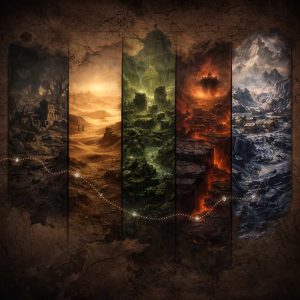
 When people talk about Diablo II, they usually focus on loot, builds, or difficulty spikes. But one of the game’s quiet strengths is geography. Not geography in a realistic sense, but as a design tool. Every region feels placed, shaped, and constrained in ways that guide mood, pacing, and story, and even when players buy items for Diablo 2, those choices feel tied to the demands of each harsh, shifting environment. The world isn’t just a backdrop for combat. It actively pushes the player forward and reinforces the game’s theme.
From Act I’s muddy fields to Act V’s frozen peaks, Diablo II uses space, terrain, and environmental logic to give its world weight. Even with the technical limitations of 2000, Blizzard North built regions that feel grounded, hostile, and purposeful.
Act I: Containment and Corruption
The game opens in a contained rural space. Act forests, walls, and ruins box me in. Paths curve and narrow. Visibility is limited. You’re rarely given a wide view of the land. That design choice does a lot of work.
The geography reinforces vulnerability. You aren’t exploring a grand continent yet. You’re trapped in a rotting frontier where corruption has crept in quietly. The wilderness feels close and claustrophobic, even outdoors. Towns are small and defensive. Dungeons stack downward, pushing you beneath churches and monasteries that once represented safety.
Vertical geography matters here. Each descent feels like a literal step toward the source of evil. By the time you reach the catacombs, the world above feels distant. The land has already failed.
Act II: Exposure and Distance
Act II flips the spatial logic. The desert is vast, open, and harsh. Sightlines are longer. Enemy packs come from all directions. The environment offers little cover, which makes the player feel exposed rather than trapped.
This shift isn’t just visual. Navigation becomes about endurance. You cross long stretches of sand, dig through ancient tombs, and travel outward instead of downward. Even the city of Lut Gholein feels porous, with open gates and flowing trade routes. It’s alive, but fragile.
The Arcane Sanctuary breaks the rules on purpose. Floating platforms, sharp angles, and impossible geometry interrupt the grounded desert logic. That contrast signals that you’re no longer dealing with regional corruption. You’re touching something cosmic and unstable. Geography becomes abstract right when the story widens.
Act III: Oppression Through Density
If Act II is about openness, Act III is about overload. The jungle is thick, wet, and confusing. Paths are hard to read. Enemies blend into the environment. Progress feels slow and frustrating, by design.
The geography here creates psychological pressure. You aren’t lost because of poor direction. You’re lost because the land itself resists you. Rivers block paths. Ruins overlap. Civilization feels swallowed rather than abandoned.
Kurast’s layout reinforces decay. Buildings lean into water. The stone is cracked and overgrown. The city doesn’t guide movement cleanly. It obstructs it. When you finally reach Travincal, the space tightens again, signaling a return to ritual, control, and hierarchy. The jungle gives way to structured evil.
Act IV: Compression and Focus
Act IV is small, but deliberate. The world collapses into a single fortress floating over hell. There’s no wandering. No side routes. Geography becomes linear and symbolic. The Pandemonium Fortress is a safe space suspended over chaos. You can see the abyss below, but you’re kept on narrow paths and clean lines. That contrast keeps tension high. There’s no illusion of escape or exploration anymore. You are here to finish something.
The Chaos Sanctuary strips geography down to function. Straight paths. Clear arenas. The environment stops telling regional stories and starts reinforcing finality. Space becomes ritualized, almost ceremonial.
Act V: Resistance and Ascent
Act V reintroduces scale, but with intent. The frozen north is harsh and elevated. Movement feels heavier. Enemies are more challenging and more organized. You’re no longer reacting to corruption. You’re pushing back against it.
Verticality returns, but this time it’s upward. Climbing Mount Arreat feels earned. The Worldstone Keep stacks levels high instead of deep, reversing Act I’s descent. Geography mirrors the narrative shift. This isn’t about uncovering evil. It’s about confronting it directly. Harrogath itself reflects that tone. It’s fortified, communal, and tense. The land hasn’t fallen yet. It’s holding the line.
Why It Still Works
Diablo II’s geography succeeds because it’s consistent. Each region follows its own spatial logic, then breaks it when the story demands. The game doesn’t rely on exposition to explain its world. It lets terrain do the talking.
You feel danger before you understand it. You feel relief when space opens up, and dread when it closes in. That emotional response comes from geography as much as monsters or music.
Even today, with far more powerful tools available, few games use space as deliberately. Diablo II proves that worldbuilding doesn’t need to be big. It needs intent.


